Skip to content
  • 0 Votes
    1 Posts
    2 Views
    S
    Speak to any small business owner right now and you’ll hear the same thing. Costs are rising. Pressure is building. And somehow, they’re expected to carry more, with less control. There’s a new player entering UK employment law - The Fair Work Agency On paper, it sounds like a good thing. Fair pay. Fair treatment. Better protections for workers. No one’s arguing with that. But there’s a question sitting underneath all of this that hardly anyone is asking: Fair for who? The system is getting stronger… for employees Let’s be clear, employees are about to become more protected than ever. Under the latest changes, they’ll have: • Enforcement of minimum wage and holiday pay through the state • A legal requirement for employers to inform them of their right to join a union • Greater access to union representation • External bodies stepping directly into workplace disputes This is a system that’s becoming: More active. More structured. More supportive. And again that’s not a bad thing. But it’s only one side of the story. Now let’s talk about the other side The person running the business. The one who: • Pays the wages • Handles compliance • Carries the financial risk • Keeps the whole thing from falling apart Let’s be honest for a second… What does “fairness” look like for them? Because right now, it looks like this: • No minimum income protection • No statutory holiday pay • No sick pay • No enforcement body acting on their behalf If things go wrong, they don’t call for help. They absorb it. Out of their own pocket. “But business owners can join organisations…” Sure. Of course they can. An employee can join a union for £10–£20 a month. A business owner can join something like the Federation of Small Businesses for a similar cost over a year. On the surface, that sounds balanced. But that’s not where the real difference lies. One is built into the system. The other isn’t. Employees: • Are automatically protected by law • Have enforcement bodies acting for them • Are actively informed of their rights • Can access support inside the workplace Business owners: • Have to go looking for support • Have to pay for it themselves • Have no equivalent enforcement body • Have no obligation from the system to support them One is built in. One is left to chance. That’s not a small difference. That’s the whole game. And at the same time… control is shifting Here’s where it gets more complicated. Business owners are still responsible for everything. But they’re not in full control anymore: • Wage floors are set by the government • Taxes are being driven upwards all round • Compliance requirements are expanding fast to reflect incoming legislation • Enforcement is becoming more proactive by the state So the original deal used to be: Take the risk. Keep the control. Now? Take the risk. Share the control. Carry the whole responsibility. That’s a very different equation. The question no one has properly answered What is a “worker”? Because this entire system is being built around protecting workers. But in reality… it’s not protecting all of them. Think about a small business owner. They’re: • Delivering the service • Managing clients • Handling operations • Wearing five different hats • Working long hours just to stay afloat Are they not working? Of course they are. But legally? They’re classified as self-employed or a company director. Which means they sit outside the very protections being created and strengthened across the system. So who represents them? Trade unions exist for employees and they play an important role. But they’re not built for business owners. And there is no equivalent system with the same: • Access • Influence • Enforcement power So what are we left with? A system where: • One side is increasingly supported, protected, and represented • The other is expected to navigate growing complexity and costs alone with no support This is where the imbalance starts to matter Because most small businesses aren’t big corporations. They’re people: People working long hours People taking financial risks People trying to build something sustainable And in many cases? They’re earning less than their own employees, especially in the early years. But none of that shows up in policy. None of it gets protected. And none of it gets supported. So what does “fair” actually mean? If fairness at work is the goal, it can’t just apply in one direction. It has to reflect how modern businesses actually operate. Because right now, a system is being built that recognises one type of worker… And ignores another. The one that makes employment possible in the first place. Final thought The Fair Work Agency may well improve fairness inside businesses. But it raises a bigger question: Who is making sure the system itself is fair? Because if fairness is the goal… It can’t depend on which side of the payslip you sit.
  • 1 Votes
    1 Posts
    16 Views
    S
    Running a small business has always required resilience and more than a dash of optimism. But right now, many owners are dealing with something much more difficult. Not just change, but the accumulation of multiple significant changes happening at the same time. I’ve named this The Policy Pile Up. I recently discussed this on the Business111 Coffee Pod with small business champion Liz Barclay, and it’s a theme that continues to dominate conversations with business owners across the UK. Click to watch here The challenge is not one policy, but many Over the past year, and especially right now, several significant changes have either been introduced or are coming into effect: Updates linked to employment legislation Increases to minimum and living wages The rollout of Making Tax Digital Each of these changes has a clear rationale. But when they arrive together, the effect is compounded and not for the faint-hearted. This is Policy Pile Up. Why this is a massive hit for small businesses In larger organisations, change is absorbed by teams and backed by deeper pockets. There are departments responsible for HR, finance, compliance and operations. In a micro or small business, those roles are generally carried by one person. The owner. That means every new requirement does not just add complexity to the business. It adds pressure to the individual running it. The impact on behaviour What I am beginning to see is not resistance to change, but a shift in behaviour. Small business owners are responding to increased complexity and risk by: Being more cautious about hiring Favouring experienced staff over training new entrants Making greater use of contractors and fractional support Delaying or scaling back growth decisions These are rational responses. But at scale, they have wider implications for UK PLC. Why stability matters Most of the incoming policies are well intentioned. However, some appear not to have been fully thought through and the combined effect of timing and implementation has clearly been underestimated. When multiple changes are introduced in a short space of time, without sufficient lead in or support, the cumulative effect can be significant. The question of what will happen in reality has not been fully addressed or at least not in conjunction with those of us with lived experience. If small businesses are to grow, create opportunities, or even survive policy change, stability is just as important as support. "Policy pile up is a business breaking recipe." A broader conversation Small businesses are often described as the backbone of the economy. Behind each one is a person making decisions, managing risk, and trying to keep everything moving forward. Ensuring those businesses are heard, understood, and supported in a practical way is essential. Because when small businesses hesitate, the effects are felt far beyond the individual business itself. Sam Acton is the founder of the Domestic Angels network of small businesses. She is a Member of the BCP Council Audit & Governance Committee and a Trustee of the Healthbus Charity. Sam has over 20 years’ experience building and supporting SMEs and regularly contributes to discussions on employment, governance and sustainable business growth in Westminster. https://www.linkedin.com/in/sam-acton/
  • Who Is Franchising Right For? (And Who It Probably Isn’t)

    Blogs
    1
    0 Votes
    1 Posts
    3 Views
    S
    Franchising is not for everyone. That isn’t reverse psychology. It’s protection. For you and for the business you’re joining. I’ve described franchising as a business in a box. But here’s the part people don’t always like hearing: Some people don’t want a box. They want a blank canvas. And that’s fine. Franchising Is Right for People Who Want a Head Start If you like the idea of building something from scratch, designing the brand, testing pricing, rewriting processes repeatedly and learning through expensive mistakes, start independently. If you’d rather open a box that already contains: • Proven pricing • Recruitment frameworks • Marketing rhythms • Compliance systems • Technology • Peer support Then franchising may suit you. The box won’t remove effort. It removes guesswork. That distinction matters. It’s Right for People Who Respect Structure Franchise systems have standards. Reporting. Brand consistency. Operating processes. Some people experience that as control. Others experience it as clarity. The most successful franchisees I’ve observed don’t feel restricted by the system. They use it. They follow it. They improve within it. They don’t constantly fight it. If your instinct is to rewrite everything immediately, franchising may frustrate you. It’s Right for People Who Want Clarity About Where They Stand Franchise systems measure performance. Not to catch you out. Not to police you. Not to keep score. But because most serious business owners want to know where they are. Are enquiries converting? Is marketing consistent? Are margins healthy? Is recruitment on track? A good franchisor is not your keeper. They are not your policeman. They are your strategic partner. They see patterns across multiple territories. They spot warning signs early. They challenge drift. They support recovery. If you like operating in the dark and resisting visibility, you will find that uncomfortable. If you like knowing where you stand and adjusting quickly you will value it. The difference isn’t capability. It’s mindset. It’s Right for People Who Are Willing to Lead, Even When It’s Awkward Franchising does not remove leadership responsibility. You will still need to recruit, market consistently, manage cash flow and handle uncomfortable conversations. In the network I lead, I’ve seen franchisees build businesses that work around school runs, family commitments and long-term lifestyle goals. One franchisee did exactly that. But she didn’t build flexibility by avoiding responsibility. She built it by stepping into ownership fully, then shaping it deliberately. The box provided the structure. She provided the leadership. Franchising Is Probably Not Right for You If… You want passive income. You dislike following established systems. You struggle with long-term contractual commitment. You want total creative control over brand and pricing. You believe buying a franchise removes the need to market consistently. None of those are character flaws. They simply align better with independent entrepreneurship. The Question Most Buyers Avoid When people assess a franchise, they analyse the opportunity. They rarely analyse themselves. Do you want freedom from structure? Or freedom because of structure? Franchising is entrepreneurial. It just operates inside a framework. For the right personality, that framework accelerates growth. For the wrong personality, it feels like a cage. The model isn’t the problem. Misalignment is. The Risk Question Most People Oversimplify People often assume franchising is the “lower risk” option. That’s only partly true. Franchising shifts the category of risk. It doesn’t remove it. It gives you tested pricing, proven systems, operational frameworks and shared experience. But commercial risk still exists. You can follow a system and still need resilience. You can operate within a structure and still need consistent marketing. You can buy a proven model and still face recruitment challenges. The difference isn’t whether risk exists. It’s where the risk sits. If you start independently, your risk sits in designing the model correctly. If you buy a franchise, your risk sits in executing the model consistently. Neither is risk-free. They are different types of risk. So the real question becomes: Do I want to build the system and absorb the risk of getting it wrong? Or do I want to operate within a tested system and accept the responsibility of running it properly? That’s a much more honest comparison. Final Thought Franchising: Reduces guesswork. Does not remove responsibility. Reduces model risk. Does not remove execution risk. The question isn’t whether franchising is safer. It’s whether you prefer to take your risk in creation or in implementation. Alignment creates resilience. Optimism alone does not. Sam Acton is the founder of the Domestic Angels network of small businesses. She is a Member of the BCP Council Audit & Governance Committee and a Trustee of the Healthbus Charity. Sam has over 20 years’ experience building and supporting SMEs and regularly contributes to discussions on employment, governance and sustainable business growth in Westminster. https://www.linkedin.com/in/sam-acton/
  • What to Look Out for When Buying a Franchise

    Blogs
    1
    0 Votes
    1 Posts
    1 Views
    S
    If you’re thinking about buying a franchise, you’re not buying a product. You’re entering a long-term commercial relationship. I often describe it as a business marriage. And like any long-term commitment, the wrong match can be expensive, stressful and difficult to unwind. You are tying yourself to a brand, a leadership team and a system for five to ten years. There will be good months. There will be harder ones. There will be disagreements. And there will be times when both sides need to engage constructively. So before you get carried away with the brochure, ask yourself: Do I understand who I’m committing to? Because that matters more than the logo. Know What They Expect From You Every franchise network has an unspoken expectation. Some expect fast growth. Some expect steady consistency. Some expect owner-operators. Some expect you to build a management structure quickly. Ask them directly: What does a successful franchisee look like here? And listen carefully. If their answer sounds like “everyone does brilliantly”, you’re not getting the full picture. In my experience, the franchisees who succeed are the ones who follow process, keep marketing even when the phone/inbox seem quiet and don’t disappear when something goes wrong. That won’t suit everyone. And that’s fine. Understand the Real Financial Reality of the Franchise - Follow the Money Properly Think of franchising less as a short-term trade and more like buying property. Some buyers renovate quickly and aim to realise value sooner. That demands capital, speed and resilience. It can work, but it’s rarely effortless. Others hold and build steadily, prioritising stable income, operational strength and long-term equity. The important thing is understanding which approach you’re taking before you commit, and whether the franchise system supports sustainable growth rather than short-term optimism. You don’t need guarantees. But you do need clarity. Ask: What does year one usually feel like financially? Not just turnover. Feel like. Is it tight at first? How much working capital do most people really need? When do things typically stabilise? What are the ongoing royalty percentages? Is there a marketing levy? If the answer is smooth and easy, be cautious. Every business has a build phase. Even good ones. Check the System Works Without the Founder This is a big one. Does the model work because the founder is brilliant? Or does it work because the systems are transferable? Early-stage franchises may still be evolving, and that’s not automatically a red flag. But you need to see evidence that performance comes from process, not proximity to one individual. Look for documented systems, not just stories. If everything still revolves around the founder personally, you’re not buying a system yet. You’re buying access. And access doesn’t scale. Speak to the Franchisees Without the Franchisor Present Not the polished introduction. The honest conversation. Ask them: What surprised you? What was harder than you expected? Would you do it again? Listen for hesitation. Listen for warmth. Listen for reality. Healthy networks aren’t full of robots repeating a script. They’re full of business owners who know it’s work, but worth it. If access to franchisees feels controlled or overly managed, ask yourself why. Understand the Contract Like You Would a Marriage How long are you committing for? What happens if you want to sell? What happens if you fall out? What happens if you underperform? Pay particular attention to termination clauses, renewal conditions and resale rights. You don’t enter a marriage assuming divorce. But you do understand the commitment you’re making. A franchise agreement is no different. If you feel rushed to sign, slow down. A strong franchise opportunity can withstand scrutiny. It is always recommended that you review the agreement with a solicitor experienced in franchise law. Personality Fit: The Bit People Avoid Franchising is not less entrepreneurial. It’s entrepreneurial within boundaries. Sometimes the problem isn’t the franchise. It’s the buyer. If you dislike structure, you will resent reporting requirements. If you struggle with accountability, you will resist guidance. If you want total autonomy, brand standards will frustrate you. That works brilliantly for some people. It irritates others. The important thing is knowing which one you are before you sign. In the next article, we’ll explore this question in depth, because understanding your own operating style is just as important as evaluating the franchise itself. Final Thought When you’re considering a franchise, don’t just ask: Is this a good opportunity? Ask: Are we a good fit? Because this isn’t a transaction. It’s a partnership. Partnerships only work when both sides understand what they’re stepping into. Due diligence is not scepticism. It’s peace of mind. Sam Acton is the founder of the Domestic Angels network of small businesses. She is a Member of the BCP Council Audit & Governance Committee and a Trustee of the Healthbus Charity. Sam has over 20 years’ experience building and supporting SMEs and regularly contributes to discussions on employment, governance and sustainable business growth in Westminster. https://www.linkedin.com/in/sam-acton/
  • 0 Votes
    1 Posts
    1 Views
    S
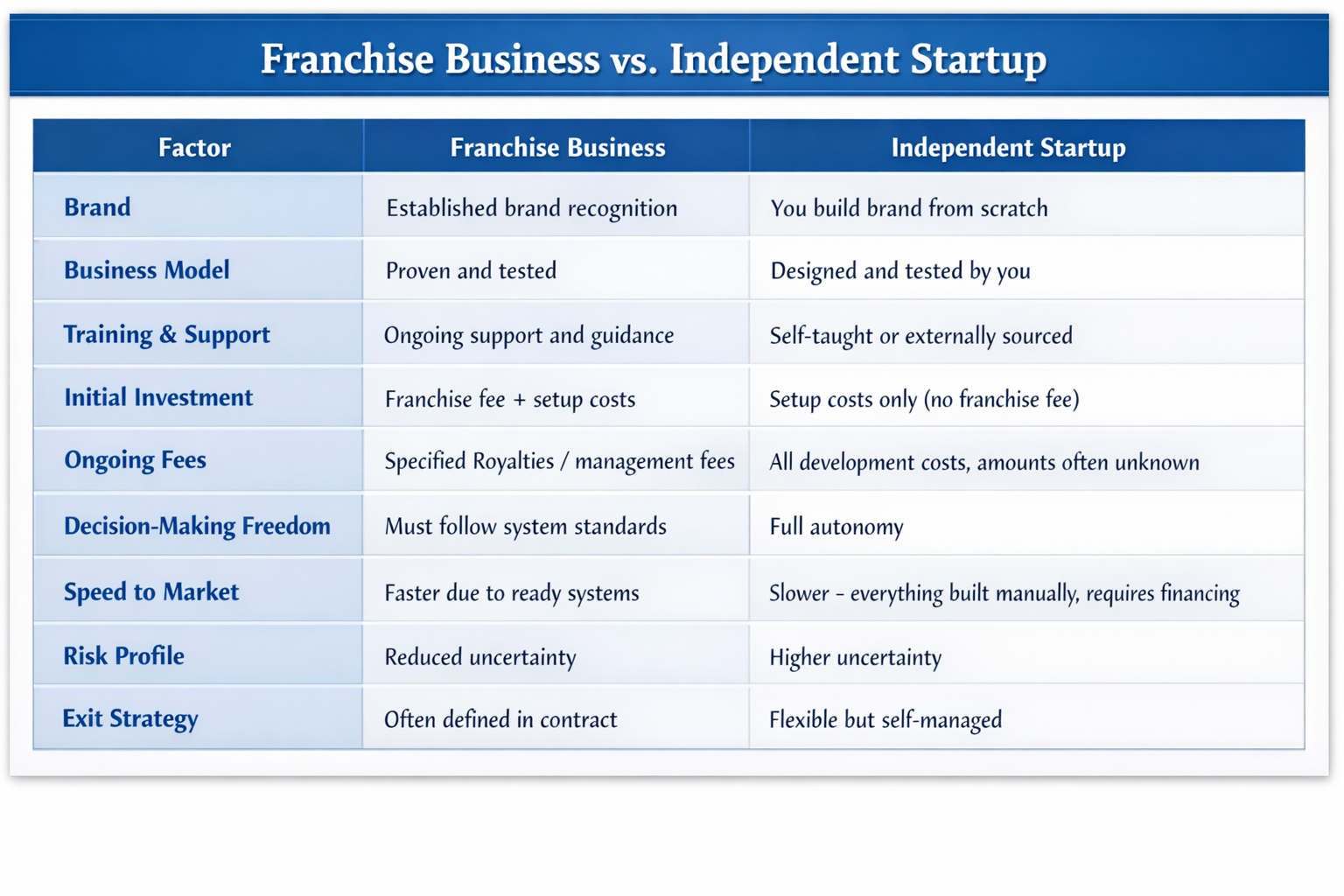
    If you’ve ever considered buying or investing in a franchise, you’ve probably wondered whether it’s a shortcut to business ownership or just an expensive mistake waiting to happen. Is franchising a safer way to start a business? Or is it simply entrepreneurship with rules attached? Having built and led a nationwide franchise network and worked across the wider franchising sector for years, I’ve seen franchising from both sides. The polished brochure version and the operational reality behind it. Franchising is neither a shortcut nor a safety net. It is a commercial structure. And structures only work when understood properly. In this article, I’ll explain exactly what franchising is, what you’re really buying, and where people often get it wrong. What Is Franchising? It’s a Business in a Box. But Read the Small Print. My favourite description for franchising is a business in a box. It’s the simplest way to explain it. Open the box and inside you’ll find: • A brand • A proven operating model • Training • Processes • Marketing frameworks • Systems • Support • Guardrails Close the box and walk away, though, and nothing happens. That’s the part people forget. What Are You Actually Buying When You Invest in a Franchise? When someone joins a franchise network they are not buying a job. They are not buying guaranteed income. They are not buying freedom on day one. They are buying a structured route into business ownership. In legal terms, they are setting up and running their own company. Maybe they recruit a team. They manage their customers. They carry commercial responsibility. What the franchisor provides is the box, filled with processes, pricing structures, recruitment frameworks, marketing materials, compliance systems and technology. That box of goodies dramatically reduces your guesswork. It does not remove effort. **What Is Franchising in Simple Terms? Franchising is a legal agreement where:** • You (the franchisee) operate your own company • You trade under an established brand • You follow an agreed operating model • You pay an initial franchise fee • You pay ongoing royalties or management fees • You commit to a contract term (typically 5–10 years) • You are granted a defined territory • You agree to brand standards and compliance requirements In short, franchising is regulated business ownership under a contractual framework, not employment, not passive income, and not guaranteed success. What It Looks Like in Real Life As the founder of Domestic Angels, I believe in the model. However, this article is not about selling a franchise. It is about explaining what franchising actually involves.. Let me tell you about Amy. Amy didn’t start as a franchisee. She started as an Angel, one of the team. Amy understood the standards. The systems. The culture. She saw how the business operated from the inside. Then she made a decision to step up and invest in the franchise. That’s important. She wasn’t buying an idea. She was investing in a proven model she had already experienced. That reduced her uncertainty but it didn’t eliminate the emotional weight of stepping into ownership. When she took on her territory, Amy wasn’t suddenly handed success. She had to: • Recruit and build her own team • Market locally • Manage cash flow • Have difficult conversations • Make decisions without someone holding her hand The box gave her clarity. It gave her pricing structure. Recruitment processes. Onboarding systems. Technology to manage scheduling, compliance and payroll integration. But she still had to lead. Three years on, Amy runs her Domestic Angels business around her two small children. She does the school runs. She works minimally in school holidays. She grows in term time. She has built a reliable team who care for her clients. The box didn’t build that life. She did. The box gave her the structure to build it deliberately rather than accidentally. Not every franchisee chooses to build their business this way. Amy’s story illustrates what structured ownership can enable when applied consistently. Why Franchising Exists: Reducing Risk and Learning Curves Starting a business completely independently means: You create the brand. You test pricing from scratch. You design your own systems. You learn by trial and error. You pay for your own mistakes. Franchising compresses that learning curve. You are buying time. You are buying experience. You are buying someone else’s battle scars. But here’s the honest bit. You still have to build it. The box doesn’t market for you. The box doesn’t recruit for you. The box doesn’t lead your team for you. You do. Franchise vs Independent Business: What’s the Difference? [image: 1771957856149-franchise-business-vs-independent-start-up-graphic.png] The key difference isn’t whether one is “better.” It’s whether you value autonomy over structure or structure over autonomy. Franchising trades some creative freedom for reduced guesswork. Independent business offers total control but total responsibility for designing every system from scratch. In my experience, the decision between franchising and starting independently is less about which is superior and more about personality alignment. Entrepreneurs who value autonomy above all else may find franchise systems restrictive. Those who value structure, frameworks and shared learning often accelerate faster within one. The Misunderstanding That Causes Problems Franchising has polished itself very well over the years. Brochures are sleek. Case studies look effortless. Awards shine. And somewhere along the way, parts of the sector allowed people to believe this was “safe” business ownership. It is structured. It is supported. It is lower risk than starting blindly. It is not risk free. As the leader of a nationwide franchise network, I can tell you this with confidence: The franchisees who succeed are not necessarily the most experienced or the most confident. They are the ones who respect the box. They follow the process inside it. They ask for support when they wobble. They keep marketing when the phone is quiet. They keep recruiting when it feels uncomfortable. They treat it like the business it is. Franchising is not for people who resent structure, resist accountability, or expect income without leadership responsibility. The franchising sector has matured significantly over the past two decades. However, as with any industry, not all franchise opportunities are created equal. Commercial performance varies widely depending on leadership, model strength, sector demand and individual execution. Due diligence matters. So What Is Franchising, Really? Franchising is entrepreneurship with scaffolding. It is ownership with parameters. It is independence within a contractual framework. It reduces uncertainty. It does not remove responsibility. For some, that structure is empowering. For others, it feels restrictive. The difference lies in expectations. If you’ve been weighing up whether franchising is a shortcut or a smart structure, you now understand what it really is, ownership with support, not ownership without responsibility. The question isn’t whether the box looks impressive. It’s whether you’re ready to use it. As someone who works daily within the franchising sector, I’ve seen how powerful this model can be when understood properly and how damaging misunderstandings can be when it isn’t. If you’re comparing franchising with starting independently, your next step should be understanding the real cost differences between the two including franchise fees, royalties and hidden expenses. That’s exactly what we’ll break down in the next article so you can assess franchising with clarity rather than optimism. Sam Acton is the founder of the Domestic Angels network of small businesses. She is a Member of the BCP Council Audit & Governance Committee and a Trustee of the Healthbus Charity. Sam has over 20 years’ experience building and supporting SMEs and regularly contributes to discussions on employment, governance and sustainable business growth in Westminster. https://www.linkedin.com/in/sam-acton/
  • Day One Statutory Sick Pay Is Coming

    Blogs
    1
    0 Votes
    1 Posts
    58 Views
    S
    Here’s what I’ve been thinking about and what we’ve been doing so far. Like it or not, day one statutory sick pay is being introduced. For many small and medium-sized businesses like mine, it will change the cost and risk profile of employing people. Much of the commentary so far has focused on whether this is fair, affordable, or another burden on employers. Those debates will continue and I absolutely encourage you to get involved, say your bit and fight your corner. It’s essential. Having a voice is a privilege. At the same time though, the more useful question is a practical one: Is your business designed to absorb absence, or does it rely on perfect attendance to function? Because the legislation itself is not what creates pressure. It exposes it. Let me explain. Absence has always been a cost. We just didn’t have to face it on day one. Sickness absence is not new. What is changing is who carries the cost, how quickly it appears, and how visible it becomes. In many SMEs, absence has traditionally been absorbed informally: • Work redistributed at short notice • Owners stepping in • Standards slipping temporarily • Overtime increasing • Productivity dipping without being measured In short, all rather relaxed, flexible and human. Day One SSP does not create absence, but it forces us all as business owners to acknowledge its real financial impact rather than hoping it evens out over time. The real risk is dependency, not legislation The businesses that feel this change most sharply are not the smallest or the least profitable. They are the ones that rely heavily on individuals rather than systems. Where one person not turning up means: • Work cannot be delivered • Customers are affected immediately • The owner is pulled back into operations • Costs rise without warning That is not a sick pay problem. It is an operating model problem which in a labour dependent business is a headache of a challenge. What we’ve changed in practice, and why it matters now Ours is a labour dependent business where people work alone and independently, absence has a direct and immediate impact. Probably one of the worst business scenarios. There is no easy cover, no shared workload, and no buffer. So rather than pretending this legislation will not affect behaviour, we have accepted that it requires a more structured and deliberate approach to absence management. That does not mean being unkind. It means being clear. Here are some of the changes we have introduced that you may want to consider. 1. Tighter absence reporting rules A text message for any absence is no longer sufficient. If someone is unwell, they must phone in and have a conversation for each day they are self-certifying. This removes ambiguity and reinforces that absence is a live operational issue, not an admin task. 2. Daily self-certification during absence Staff are required to complete a self-certification form for each day they are absent. This creates consistency, clarity and a proper record, rather than relying on memory or informal updates. 3. More formal return-to-work conversations Return-to-work interviews are now structured and recorded. They are not disciplinary by default, but they are purposeful. They provide an opportunity to understand what happened, reset expectations and identify any underlying issues early. 4. Using data to spot patterns, not to punish Recording absence properly puts managers and business owners in a much stronger position to see patterns that need addressing. This might be repeated short-term absence, timing issues, or workload pressures. Without records, none of that is visible or useful in a disciplinary scenario. 5. Tighter medical information at recruitment Whilst you cannot force disclosure, you can be clear about expectations. Our medical forms are more robust, and where something surfaces later that was not disclosed up front, we are in a stronger position to challenge the revelation through a fair but informed conversation. 6. Clear boundaries around what counts as sickness Being off because off for a sick pet or for great aunty ‘Tilda twice removed’s funeral is no longer an affordable option. These situations require different conversations and different solutions. Blurring the lines helps no one. 7. Training managers to handle this properly We are rolling out structured training for our managers, they are franchisees so business owners like yourself, so they can adapt confidently to this more formal, belt-and-braces approach. This is essential. Poorly handled absence management damages trust and costs money. Done well, it creates clarity and consistency. 8. Reviewing and re-launching absence policies Policies have been reviewed, updated and simplified. Everyone knows where to find them and what they say. A policy that exists but is not understood is no protection for anyone, at all. If you are an SME owner who is used to being flexible and human, trust me, I hear and feel your pain with these changes. The discipline and additional admin, yuk. Try focussing on the output, absence reduction=cost reduction. You can do it. The uncomfortable conversation - pricing Day One SSP is inflationary. There is no value in pretending otherwise. Please do not sit back and wonder whether you can absorb the additional cost of Day One SSP. The government has legislated it, just as it legislates for the Living Wage. That means, like it or not, there is now another cost element that needs to be passed on to customers over time. Most businesses already have a formula they use for annual price reviews to cover increases such as Living Wage, National Insurance and general overheads. Day One SSP now needs to sit alongside that as a separate consideration. If you are not a numbers-happy person (you’re in good company), this will feel like a pain in the proverbial. There is no neat rule of calculation that fits every business type or sector. We approached it pragmatically. We looked at national average sickness figures from two recognised sources. One quoted 9.5 days per year, the other 4.5. Not hugely helpful, so we settled on 7 days as a median and ran our calculations from there. Is it perfect? Probably not. Will it be sufficient? Time will tell. But we have done something. And at this point, doing something sensible and documented to protect your bottom line is far better than doing nothing and hoping it all evens out. My final thoughts If you’ve been in business for some time and this feels overwhelming, remember you pivoted through a pandemic, so you can definitely pirouette through an Employment Rights Act. The introduction of day one statutory sick pay is as much about business resilience as it is personal resilience. You do have a bit of time yet, so break things down. Tasks, decisions, ideas for your business. Cup-of-tea-sized chunks. Don’t aim for perfection, just aim for done. You can polish it later. And for those of you with an appetite for lobbying, remember the game isn’t up yet. Your MP and your favourite journo need to hear from you. Real-life stories, facts and figures, shared while legislation is being proposed and introduced, really do influence how it forms (or so I’m always being told). You are a business leader, and your voice matters. Sam Acton is the founder of the Domestic Angels network of small businesses. She is a Member of the BCP Council Audit & Governance Committee and a Trustee of the Healthbus Charity. Sam has over 20 years’ experience building and supporting SMEs and regularly contributes to discussions on employment, governance and sustainable business growth in Westminster. https://www.linkedin.com/in/sam-acton/
  • Making Tax Digital

    Menta.org.uk
    1
    0 Votes
    1 Posts
    54 Views
    T
    This is your community space for business help and discussions if you are a client of Menta.org.uk. We have teamed up with our partners - www.business111.com to provide this community forum and all of their curated information to help you 24/7. To take part in the community space please register. It's free.
  • Mayoral elections 2026

    Menta.org.uk
    1
    0 Votes
    1 Posts
    34 Views
    T
    Your thoughts? The government have announced that they are minded to move the election from May 2026 to May 2028. This election is being held because Norfolk County Council and Suffolk County Council applied to be part of the Government's Priority Programme for Devolution. This involves the creation of a new Combined County Authority covering both areas. The Combined County Authority will be led by the elected Mayor. The new authority will not replace local councils. Instead, it will act as a strategic authority, sitting between local councils and national government. Its purpose will be to handle key areas at a strategic level.
  • Audit Reform and governance Bill Scrapped

    Announcements
    1
    0 Votes
    1 Posts
    22 Views
    L
    The Governemnt has announced that it's scrapping the Audit Reform and Corporate Governance Bill. The reason given is to reduce costs on firms. This programme of refrom has been in the pipeline and kicked into the long grass several times, since the collapse of the big construction company Carillion in 2018. It took thousands of small construction firms with it and the ripples reached out as far as small micro businesses on the sidelines like cafes. This isn't good news and leaves gaps which could mean that future corporate failures have a similar impact. Cutting red tape to boost the growth agenda has consequences and there will be losers.
  • Welcome to our first community space

    Your Community
    1
    0 Votes
    1 Posts
    26 Views
    T
    Hello - this is our opportunity to provide a space for 24/7 help and discussion. This is your space so please use it. Alex Till Chief Executive Officer (CEO)
  • 0 Votes
    1 Posts
    35 Views
    L
    Have you tried to find money to fund your business? If so did you need working capital or money to invest for growth. If the banks are persuaded by Government to lend more to small businesses that could be positive but only if businesses get the right typr of funding for the stage their business is at. Just getting a loan isn't the answer if the business will have problems, or get into deeped problems, trying to repay that loan or if it comes with the worn strings attached. I know of businesses where lending was dependent on personal guarantees and those guarantees were called on when the repayments fell behind. I know of businesses that got loans but weren't able to grow the business and ended up worse off trying to create enough income to service the loans. We need support for businesses to make sure they are ready for the funding, are looking for the best kind of funding for the stage their business is at and have the right support to make sure they are using the funding in the right way. It's about more than just money. Please let me know your experience.
  • Why your tax bill might be a lot bigger than you expected

    Blogs
    1
    0 Votes
    1 Posts
    25 Views
    L
    The UK’s payments on account system catches a lot of new sole traders by surprise. Payments on account are advance payments towards your next Self Assessment tax bill (in this case for the year 25/26). You pay them on top of any tax you owe for the previous (24/25) tax year. HMRC uses payments on account to help spread the cost of your tax across the year rather than collecting it all at once. They apply mainly to: • self employed people • landlords • anyone with untaxed income They are based on last year’s tax bill HMRC assumes your income next year will be similar to the previous year. So each payment on account is half of your previous year’s tax bill. You make two instalments • 31 January • 31 July You may also need a “balancing payment” If your actual tax bill ends up higher than the two instalments you’ve already paid, you pay the difference the following 31 January. If you paid too much HMRC will refund you. You won’t be asked to make payments on account if either: • your last tax bill was £1,000 or less, or • 80% or more of your tax was already collected at source (e.g., PAYE). If your tax bill last year was £3,000, HMRC will ask you to pay: • £1,500 on 31 January • £1,500 on 31 July towards next year’s bill. If your actual bill ends up higher, you pay the extra as a balancing payment the following January. It’s particularly tough to find the additional money to pay on account if you’re fairly recently self-employed and weren’t expecting it. You may have put aside money to cover tax on the amount you were earning but not to cover the additional amount. HMRC doesn’t automatically require new sole traders to pay tax on account in their first year. The rules above apply, You will have to make Payments on Account if both of these apply: Your tax bill for the year is more than £1,000, after subtracting any tax already deducted at source (e.g., PAYE). Less than 80% of your total tax was collected at source. If those conditions apply, HMRC will ask you to make: • First payment on account: 31 January • Second payment on account: 31 July Each is normally 50% of your previous year’s tax bill. You won’t have to make Payments on Account if: • Your tax bill is £1,000 or less, or • More than 80% of your tax was already deducted (e.g., you still have PAYE employment), or • HMRC decides your first year’s liability is too low to trigger the system. This is very common for brand new sole traders whose first year is part time, low income, or mixed with PAYE work. If: You start self employment in 2025/26 and owe £600 in tax. → No payments on account. You owe £2,500, but you also have PAYE employment that covered 85% of your total tax. → No payments on account. You owe £2,500, and PAYE only covered 20%. → Yes. You will have to make payments on account. If you’re unsure whether you’ll cross the £1,000 threshold, try to set aside 20–30% of your profits so you’re covered whether payments on account apply or not. This is an example where a qualified accountant can keep you right. You may worry that the fees will be too expensive but accountants will keep you safe and probably save you money in the long run. Check their qualifications. Unqualified people calling themselves accountants have been known to give poor advice.
  • A-Z of getting started in 2026

    Blogs
    1
    0 Votes
    1 Posts
    25 Views
    L
    A–Z of Starting a Small Business in 2026 Here are the basics. You’ll want more detail and perhaps assistance to get all the processes right. Business111’s search function will point you in the right direction. Accounting, Automation and AI Set up bookkeeping from day one. Use simple tools (FreeAgent, QuickBooks, Xero) and automate invoicing, reminders, and expenses. AI tools can draft proposals, chase payments, and analyse cash flow. Business Plan & Business Model You don’t need a 40 page plan. You need clarity on: • what you sell • who you serve • how you make money • how you deliver • what it costs A one pager is enough to start with and constantly review and revise it. Cash Flow All important. Cash flow is the No.1 reason micro businesses fail. Build a buffer, forecast monthly, and protect yourself from late payments. The figures in your business are what really tell you the story. Digital Presence Your online footprint is your shopwindow if your business is online only. That means: • a simple website • an online Business Profile • one social platform you show up on consistently Expenses & Efficiency Track every cost. Claim allowable expenses (keep the records) Streamline your processes from the start and avoid stress later. Funding & Finance Explore grants, start up loans, local authority schemes, and sector specific funds. January is a key reset point for many funding programmes. GDPR & Data Protection Even micro businesses must comply. Have a privacy notice, secure data storage, and clear consent processes. HMRC Registration Register as self employed or set up a limited company. Understand tax obligations, payments on account, and allowable deductions. Insurance Most businesses need at least: • public liability • professional indemnity • employer’s liability (if you hire anyone) • cyber cover is increasingly essential. Journey Mapping Map the customer journey from their first contact with your business to repeat purchase. This helps you design better experiences and reduces the chances of losing customers to your competition. KPIs (Key Performance Indicators) Track what matters: • leads • conversion rate • average order value • customer lifetime value • monthly recurring revenue (if relevant) Legal Structure Choose between: • sole trader • limited company • partnership • CIC or social enterprise Each has different tax and reporting requirements (see Business111 Resources) Marketing Strategy Pick one core channel and master it. Consistency beats complexity. Networking & Niche Communities Join local business groups, sector networks, relevant or specialist communities, and business forums. Businesses thrive through connections and sharing tips and best practice. Operations Document your processes early: • onboarding • delivery • invoicing • customer service • refunds This saves time and supports growth. Pricing Price for sustainability, not survival. Yopu won’t survive if you’re only breaking even or can’t pay yourself a salary. Review your prices regularly and make sure you aren’t undercharging, which is a very common business mistake. Quality Control Whether you sell products or services, create simple quality standards. Consistency builds trust. Risk Management Think about: • cyber security • compliance with the regulations such as tax and VAT • supply chain • financial risks • reputational risks A basic risk register is enough. Sales Strategy Know your offer, your value, and your ideal customer. Create a simple sales script or pitch. Tax Understand: • income tax • corporation tax (if Ltd) • VAT thresholds • payments on account • allowable expenses Set aside 20–30% of profits to stay safe. USP (Unique Selling Proposition) What makes you different? Your story, your values, your niche, your method, all contribute to your competitive edge. Visibility Show up regularly. People buy from businesses they recognise and trust. Website A simple, clean, accessible website is enough. Include: • what you do • who you help • prices (if possible) • how to contact you • testimonials eXpectation Management Set clear expectations with customers: • timelines • deliverables • boundaries • communication channels This reduces complaints and increases loyalty as long as you stick to your promises. Yearly Planning Set annual goals, quarterly priorities, and monthly actions. Review and adjust to make sure you can be agile enough to respond to changes. Agility is a superpower. Zero Burnout Your wellbeing is a business asset as is that of any people you take on. You need a zero tolerance approach to anything that undermines wellbeing. Set boundaries, take breaks, and build a support network to avoid the feeling of isolation. If you aren’t thriving the business won’t either.
  • 12 New Year resolutions to help your business thrive

    Blogs
    1
    0 Votes
    1 Posts
    25 Views
    L
    It’s that time of year. Many of us are thinking about how we’ll do things differently over the next 12 months with the aim of making our businesses thrive. After all the disruption and uncertainty coupled with challenges like the rising cost of doing business and customers with less money to spend, a new year seems like the ideal time for new approaches. I’ve been looking for a list of 12 resolutions, one a month, to work on over the coming year and as my business friends tell me I have to be specific, make ambitions measurable and realistic or they will end up abandoned in January. Here's my list: Build a cash flow buffer of 3–6 months Businesses fail more from cash flow shocks than poor sales. A buffer gives stability, bargaining power, and breathing space and could mean you don’t have to borrow at huge expense during the year if you have an invoice that doesn’t get paid when you expect it to. Raise prices strategically rather than emotionally Many small businesses undercharge because they’re scared of losing work or sales. Review your prices regularly, benchmark against your competitors, and increase prices realistically, adding value if you can. Automate the things you can automate Get the tech tools to do the jobs that drain your time: invoicing, chasing payments, onboarding, scheduling, stock checks. Yes they cost but they’re a real investment freeing you up to spend on the business rather than in the business. Time is better spent thinking and planning than filling in forms. Diversify income streams 2026 is the year of multiple revenue channels: • digital products • subscription add-ons • partnerships • B2B services • seasonal bundles Even one new revenue stream can make a business more resilient. Get paid fairly Many businesses lose money to unfair payments like overdue invoices or unfair terms in a contract. Change that: • Check the payment terms offered and negotiate better ones • automate reminders • ask for deposits, up front payments to cover stuff you have to pay for before work starts, or payment in stages as work is completed • charge interest and compensation if the payments are overdue (this is set out in legislation) la • use invoice chasing tools Getting money in when you expect it to come in can save you the expense of borrowing just to stay afloat. Invest in keeping your customers rather than having to find new ones Returning customers cost less and spend more. Think about: • loyalty perks • follow up support • personalised check ins • feedback loops Gather your data Even the smallest businesses can track: • cost per lead • conversion rates • top performing products • busiest days • customer lifetime value When you collect useful data you can review them regularly and use them to decide next steps. Build you story and spread it Businesses win on authenticity. Refresh your brand story, update your website, and show up consistently on one chosen platform to increase trust. Create a 12 Month Content Plan • 4 themes • 12 monthly focuses • weekly posts A plan helps reduce stress and builds authority. Factor in your own wellbeing and boundaries Burnout is real: • set working hours • take breaks • delegate • protect weekends If you are healthier the business will be too. Review your compliance and risk management All the following need regular auditing: • data protection • cyber security • employment practices • accessibility Build your support network Businesses thrive with the help of mentors and business advisers as well as groups of people who all want to help each: • local business groups or groups in your sector • sector networks • minority led communities • disability inclusive business forums • peer groups You may think you don’t have time for networking but networking with the right supportive groups can save you time and save you stress, isolation and money, perhaps even save your business. Here’s wishing all businesses a prosperous and thriving 2026.
  • New Employment riights in the pipeline for 2026/27

    Blogs
    1
    1 Votes
    1 Posts
    26 Views
    L
    The new Employment Rights coming in 2026 and 2027 The UK Government’s Employment Rights Bill has been passed by Parliament and is expected to receive Royal Assent before the end of 2025. This Bill is a major shift in the UK employment landscape. The reforms included in the Bill will be phased in over 2026 and 2027 and cover unfair dismissal, sick pay, parental leave, zero hours contracts, fire and rehire, trade union rights, harassment protections, and more. Unfair Dismissal • The length of time an employee has to work for an employer (the qualifying period) in order to make a claim for unfair dismissal will be reduced from 2 years to 6 months. • The cap on compensation will be removed, meaning claims could be uncapped. • These changes are expected to come into force in January 2027. Employment Tribunal Claims • The time limit for bringing employment tribunal claims will be extended from 3 months to 6 months for most claims. • That change is expected to come into force in October 2026. Fire and Rehire • Dismissing and rehiring on worse terms becomes automatically unfair dismissal, except in cases where the employer can prove that it was genuinely financially necessary. • That change is also expected to come into force from October 2026. Trade Union Rights from April 2026 • Industrial action ballots: Minimum 50% turnout required will be required and if that’s the case a simple majority will be sufficient to allow strike action. • Union recognition: The thresholds will be lowered, meaning easier access to workplaces (physical and digital). Parental Leave & Sick Pay • Employees will have rights to paternity leave, unpaid parental leave, and statutory sick pay from day one of their employment. • Statutory Sickpay will be payable from day one and the lower earnings limit will be removed. • These changes will come in from April 2026. Zero-Hours Contracts • Employers must offer contracts with guaranteed minimum hours. • Compensation will be required for shifts cancelled at short notice. • These changes are expected from 2027. Harassment • Employers must take all reasonable steps to prevent sexual harassment and that will include harassment by third parties. This duty was Strengthened from October 2024, and will be expanded in 2026. Collective Redundancy • An employer who is making roles redundant and doesn’t consult the workforce following the regulations will face higher penalties of 180 days’ gross pay per affected employee from April 2026 Fair Work Agency • From April 2026 there will be a new enforcement body to oversee employment rights. What do employers need to do to prepare for the changes? • Update policies on sick pay, parental leave, and redundancy by April 2026. • Review dismissal procedures ahead of 2027 to manage risk of uncapped claims. • Prepare contracts for zero-hours staff to include guaranteed hours. • Train managers on the changes and on harassment prevention and union access rights. We'll be following the detials as they emerge and thinking about the unintented consequences for small and micro businesses.
  • The Employment Rights Bill

    Announcements
    1
    0 Votes
    1 Posts
    31 Views
    L
    The Employment Rights Bill passed by Parliament yesterday evening 16th Dec. There have been amendments since the proposals were first announced. There will be day one rights to sick pay and bereavement leave but there will be a 6 month period before an employee can claim for unfair dismissal. More detail coming in my blog soon.
  • How are unemployment trends looking in your sector

    General Discussion
    1
    0 Votes
    1 Posts
    29 Views
    L
    Unemployment hit 5.1%, the highest since January 2021 and wage growth slowed in the 3 months to October. Those figures were for the period before the budget, with all the uncertainty the various rumours and the speculation caused for businesses. Is that behind us now. Will business respond to the budget by getting on with the plans they had before uncertainty paused activity or will the quiet quitting we've been seeing especially in the retial and hospitality sectors continue. Let us know in the forum discussions what you're seeing in your sector.
  • Unemployment up again

    Announcements
    1
    0 Votes
    1 Posts
    23 Views
    L
    Unemployment hit 5.1%, the highest since January 2021 and wage growth slowed in the 3 months to October. Those figures were for the period before the budget, with all the uncertainty the various rumours and the speculation caused for businesses. Is that behind us now. Will business respond to the budget by getting on with the plans they had before uncertainty paused activity or will the quiet quitting we've been seeing especially in the retail and hospitality sectors continue. Let us know in the forum discussions what you're seeing in your sector.
  • £2mn funding to help small businesses cut costs

    Announcements
    1
    0 Votes
    1 Posts
    25 Views
    L
    Government announces £2 million funding boost to help more small and medium sized businesses cut costs The funding is part of a range of new measures to support small business growth. Two thirds of small and medium businesses that adopted sustainable practices like installing solar panels reported reduced costs Small businesses across the UK will benefit from the Government funding and support to help them invest in sustainability, to cut their operating costs and boost their business. More detail to come.
  • Is the economic contraction unexpected? Really?

    Blogs
    1
    0 Votes
    1 Posts
    19 Views
    L
    The UK economy shrank by 0.1 per cent in October according to the Office for National Statistics (ONS). That’s on top of the 0.1% decline in September. There was no growth in August. The economy hasn’t grown since June. For a Government that put so much emphasis on the need for the economy to grow so that there’s money to spend of public services that’s not a good look. However, the word that’s been exercising me in the headlines is ‘unexpectedly’. Apparently, the fall was unexpected. Most economists were expecting to see a rise of 0.1 per cent for October, driven by Jaguar Land Rover’s recovery after the cyber attack on it in August which hit the manufacturing sector hard. I’m not an economist but as a business journalist I could often be heard to remark that if you asked 40 economists for their forecasts, you’d get 40 different assessments. So why then were economists apparently agreeing on the likelihood of growth? I think it’s because they are fixated on, and talking to, the wrong companies. The small and micro firms in the UK are the bellwether. What’s happening on the high streets, the industrial estates and on the other sector frontlines is where forecasts would be more accurately based. We’re in an economic mess with quiet quitting of small businesses going on all over the UK. Small business owners when asked are fairly optimistic about their own prospects next year but not about the wider economic picture or about the ecosystems they’re working in. The budget didn’t help, piling on the agony after the wages and NIC rises in April 2025. The shenanigans before the budget with the kite flying and leaks of supposed definite changes to be announced in the budget exacerbated the situation. Business owners kept their hands firmly in their pockets even if they did have money to spend, because of the uncertainty. I’d love to see the counter factual calculation that could show what the growth figure would have looked like had the seeds of uncertainly not been so widely and so frequently spread around the business community. The budget itself was a damp squib in terms of encouragement for businesses to get their hands out of their pockets and invest to grow. Small and micro owners, despite all the derogatory talk about lack of ambition for growth and productivity would love to adopt technology, hire talented people, reskill and upskill and grow. They need to feed families who are facing a cost of living crisis that’s been hanging around for years and they need to tackle their own cost to doing business crisis that’s been holding them back since 2008. We need support, radical solutions and a real voice at the table when the economists and politicians are musing about their forecasts and policies. The smallest businesses get the least air time but that’s the place to start. Given that there was next to nothing in the budget for the biggest business sector, the 0-50 employee businesses that provide 47% of the employment in the private sector, contribute £1,8trillion of our UK income and are the biggest innovators and job creators in good times, the budget needed to be radical, growth-focused and ambitious. Even the crumbs of good news, like more money for the British Business Bank to lend, weren’t new. We’re not growing, investing creating jobs and fewer of us are exporting. If you make it this hard for the small business owners, who are renowned for getting going when the going gets tough then you should be expecting the economy to reduce rather than grow. We need the government to understand the needs of small business, entrepreneurs, the risk-takers and reward them, encourage them, incentivise them and get their help to build a clear plan for growth. Only then, and of course I’m not an economist so what would I know, will we get 3 or 4% growth and that growth will lead to further growth. I do know that you have to build from the bottom up rather than the top down. Trickle down has been shown not to work. Trickle up can, with the will and the power, experience and innovation of our smallest businesses.