
What Is Franchising? A Clear Explanation of the Franchise Business Model
-
If you’ve ever considered buying or investing in a franchise, you’ve probably wondered whether it’s a shortcut to business ownership or just an expensive mistake waiting to happen.
Is franchising a safer way to start a business? Or is it simply entrepreneurship with rules attached?
Having built and led a nationwide franchise network and worked across the wider franchising sector for years, I’ve seen franchising from both sides. The polished brochure version and the operational reality behind it.
Franchising is neither a shortcut nor a safety net. It is a commercial structure. And structures only work when understood properly.
In this article, I’ll explain exactly what franchising is, what you’re really buying, and where people often get it wrong.
What Is Franchising? It’s a Business in a Box. But Read the Small Print.
My favourite description for franchising is a business in a box.
It’s the simplest way to explain it.Open the box and inside you’ll find:
• A brand
• A proven operating model
• Training
• Processes
• Marketing frameworks
• Systems
• Support
• GuardrailsClose the box and walk away, though, and nothing happens.
That’s the part people forget.
What Are You Actually Buying When You Invest in a Franchise?
When someone joins a franchise network they are not buying a job.
They are not buying guaranteed income.
They are not buying freedom on day one.
They are buying a structured route into business ownership.
In legal terms, they are setting up and running their own company. Maybe they recruit a team. They manage their customers. They carry commercial responsibility.
What the franchisor provides is the box, filled with processes, pricing structures, recruitment frameworks, marketing materials, compliance systems and technology.
That box of goodies dramatically reduces your guesswork.
It does not remove effort.
**What Is Franchising in Simple Terms?
Franchising is a legal agreement where:**
• You (the franchisee) operate your own company
• You trade under an established brand
• You follow an agreed operating model
• You pay an initial franchise fee
• You pay ongoing royalties or management fees
• You commit to a contract term (typically 5–10 years)
• You are granted a defined territory
• You agree to brand standards and compliance requirementsIn short, franchising is regulated business ownership under a contractual framework, not employment, not passive income, and not guaranteed success.
What It Looks Like in Real Life
As the founder of Domestic Angels, I believe in the model. However, this article is not about selling a franchise. It is about explaining what franchising actually involves.. Let me tell you about Amy.
Amy didn’t start as a franchisee.
She started as an Angel, one of the team.
Amy understood the standards. The systems. The culture. She saw how the business operated from the inside.
Then she made a decision to step up and invest in the franchise.
That’s important.
She wasn’t buying an idea. She was investing in a proven model she had already experienced.
That reduced her uncertainty but it didn’t eliminate the emotional weight of stepping into ownership.
When she took on her territory, Amy wasn’t suddenly handed success.
She had to:
• Recruit and build her own team
• Market locally
• Manage cash flow
• Have difficult conversations
• Make decisions without someone holding her handThe box gave her clarity.
It gave her pricing structure.
Recruitment processes.
Onboarding systems.
Technology to manage scheduling, compliance and payroll integration.
But she still had to lead.
Three years on, Amy runs her Domestic Angels business around her two small children. She does the school runs. She works minimally in school holidays. She grows in term time. She has built a reliable team who care for her clients.
The box didn’t build that life.
She did.
The box gave her the structure to build it deliberately rather than accidentally.
Not every franchisee chooses to build their business this way. Amy’s story illustrates what structured ownership can enable when applied consistently.
Why Franchising Exists: Reducing Risk and Learning Curves
Starting a business completely independently means:
You create the brand.
You test pricing from scratch.
You design your own systems.
You learn by trial and error.
You pay for your own mistakes.Franchising compresses that learning curve.
You are buying time.
You are buying experience.
You are buying someone else’s battle scars.
But here’s the honest bit.
You still have to build it.
The box doesn’t market for you.
The box doesn’t recruit for you.
The box doesn’t lead your team for you.
You do.
Franchise vs Independent Business: What’s the Difference?
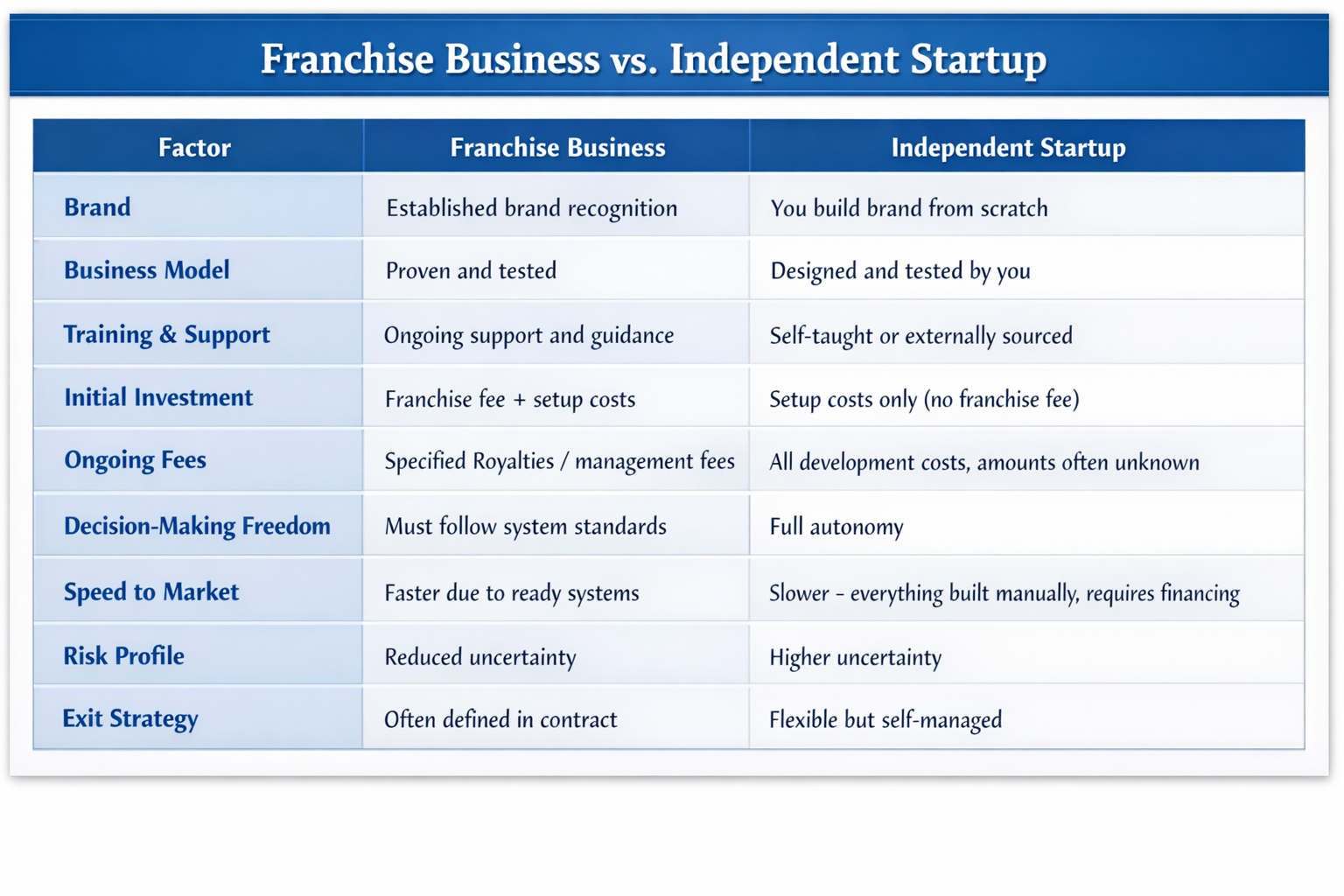
The key difference isn’t whether one is “better.” It’s whether you value autonomy over structure or structure over autonomy.
Franchising trades some creative freedom for reduced guesswork. Independent business offers total control but total responsibility for designing every system from scratch.
In my experience, the decision between franchising and starting independently is less about which is superior and more about personality alignment. Entrepreneurs who value autonomy above all else may find franchise systems restrictive. Those who value structure, frameworks and shared learning often accelerate faster within one.
The Misunderstanding That Causes Problems
Franchising has polished itself very well over the years.
Brochures are sleek.
Case studies look effortless.
Awards shine.
And somewhere along the way, parts of the sector allowed people to believe this was “safe” business ownership.
It is structured.
It is supported.
It is lower risk than starting blindly.
It is not risk free.
As the leader of a nationwide franchise network, I can tell you this with confidence:
The franchisees who succeed are not necessarily the most experienced or the most confident.
They are the ones who respect the box.
They follow the process inside it.
They ask for support when they wobble.
They keep marketing when the phone is quiet.
They keep recruiting when it feels uncomfortable.
They treat it like the business it is.
Franchising is not for people who resent structure, resist accountability, or expect income without leadership responsibility.
The franchising sector has matured significantly over the past two decades. However, as with any industry, not all franchise opportunities are created equal. Commercial performance varies widely depending on leadership, model strength, sector demand and individual execution.
Due diligence matters.
So What Is Franchising, Really?
Franchising is entrepreneurship with scaffolding.
It is ownership with parameters.
It is independence within a contractual framework.
It reduces uncertainty. It does not remove responsibility.
For some, that structure is empowering. For others, it feels restrictive. The difference lies in expectations.
If you’ve been weighing up whether franchising is a shortcut or a smart structure, you now understand what it really is, ownership with support, not ownership without responsibility.
The question isn’t whether the box looks impressive. It’s whether you’re ready to use it.
As someone who works daily within the franchising sector, I’ve seen how powerful this model can be when understood properly and how damaging misunderstandings can be when it isn’t.
If you’re comparing franchising with starting independently, your next step should be understanding the real cost differences between the two including franchise fees, royalties and hidden expenses.
That’s exactly what we’ll break down in the next article so you can assess franchising with clarity rather than optimism.
Sam Acton is the founder of the Domestic Angels network of small businesses. She is a Member of the BCP Council Audit & Governance Committee and a Trustee of the Healthbus Charity. Sam has over 20 years’ experience building and supporting SMEs and regularly contributes to discussions on employment, governance and sustainable business growth in Westminster. https://www.linkedin.com/in/sam-acton/