Skip to content
  • Categories
  • Recent
  • Tags
  • Popular
  • Users
  • Groups
Skins
  • Light
  • Brite
  • Cerulean
  • Cosmo
  • Flatly
  • Journal
  • Litera
  • Lumen
  • Lux
  • Materia
  • Minty
  • Morph
  • Pulse
  • Sandstone
  • Simplex
  • Sketchy
  • Spacelab
  • United
  • Yeti
  • Zephyr
  • Dark
  • Cyborg
  • Darkly
  • Quartz
  • Slate
  • Solar
  • Superhero
  • Vapor

  • Default (No Skin)
  • No Skin
Collapse
Brand Logo

Business111 - reliable, government-backed information and real-world experience in one simple space.

S

sam

@sam
About
Posts
6
Topics
6
Shares
0
Groups
0
Followers
0
Following
0

Posts

Recent Best Controversial

  • The Fair Work Agency Has a Problem - And Small Business Owners Are Paying the Price
    S sam

    Speak to any small business owner right now and you’ll hear the same thing.
    Costs are rising. Pressure is building.
    And somehow, they’re expected to carry more, with less control.


    There’s a new player entering UK employment law - The Fair Work Agency

    On paper, it sounds like a good thing.

    Fair pay.
    Fair treatment.
    Better protections for workers.

    No one’s arguing with that.

    But there’s a question sitting underneath all of this that hardly anyone is asking:
    👉 Fair for who?


    The system is getting stronger… for employees

    Let’s be clear, employees are about to become more protected than ever.

    Under the latest changes, they’ll have:
    • Enforcement of minimum wage and holiday pay through the state
    • A legal requirement for employers to inform them of their right to join a union
    • Greater access to union representation
    • External bodies stepping directly into workplace disputes

    This is a system that’s becoming:
    More active.
    More structured.
    More supportive.

    And again that’s not a bad thing.

    But it’s only one side of the story.


    Now let’s talk about the other side

    The person running the business.

    The one who:
    • Pays the wages
    • Handles compliance
    • Carries the financial risk
    • Keeps the whole thing from falling apart

    Let’s be honest for a second…

    What does “fairness” look like for them?

    Because right now, it looks like this:
    • No minimum income protection
    • No statutory holiday pay
    • No sick pay
    • No enforcement body acting on their behalf

    If things go wrong, they don’t call for help.
    They absorb it.
    Out of their own pocket.


    “But business owners can join organisations…”

    Sure. Of course they can.

    An employee can join a union for £10–£20 a month.
    A business owner can join something like the Federation of Small Businesses for a similar cost over a year.

    On the surface, that sounds balanced.
    But that’s not where the real difference lies.


    One is built into the system. The other isn’t.

    Employees:
    • Are automatically protected by law
    • Have enforcement bodies acting for them
    • Are actively informed of their rights
    • Can access support inside the workplace

    Business owners:
    • Have to go looking for support
    • Have to pay for it themselves
    • Have no equivalent enforcement body
    • Have no obligation from the system to support them

    👉 One is built in.
    👉 One is left to chance.

    That’s not a small difference.
    That’s the whole game.


    And at the same time… control is shifting

    Here’s where it gets more complicated.

    Business owners are still responsible for everything.
    But they’re not in full control anymore:
    • Wage floors are set by the government
    • Taxes are being driven upwards all round
    • Compliance requirements are expanding fast to reflect incoming legislation
    • Enforcement is becoming more proactive by the state

    So the original deal used to be:
    👉 Take the risk. Keep the control.
    Now?
    👉 Take the risk. Share the control. Carry the whole responsibility.
    That’s a very different equation.


    The question no one has properly answered

    What is a “worker”?
    Because this entire system is being built around protecting workers.
    But in reality… it’s not protecting all of them.

    Think about a small business owner.
    They’re:
    • Delivering the service
    • Managing clients
    • Handling operations
    • Wearing five different hats
    • Working long hours just to stay afloat

    Are they not working?
    Of course they are.

    But legally?
    They’re classified as self-employed or a company director.
    Which means they sit outside the very protections being created and strengthened across the system.


    So who represents them?

    Trade unions exist for employees and they play an important role.
    But they’re not built for business owners.
    And there is no equivalent system with the same:
    • Access
    • Influence
    • Enforcement power

    So what are we left with?
    A system where:
    • One side is increasingly supported, protected, and represented
    • The other is expected to navigate growing complexity and costs alone with no support


    This is where the imbalance starts to matter

    Because most small businesses aren’t big corporations.
    They’re people:

    • People working long hours
    • People taking financial risks
    • People trying to build something sustainable

    And in many cases?

    They’re earning less than their own employees, especially in the early years.
    But none of that shows up in policy.
    None of it gets protected.
    And none of it gets supported.


    So what does “fair” actually mean?

    If fairness at work is the goal, it can’t just apply in one direction.
    It has to reflect how modern businesses actually operate.

    Because right now, a system is being built that recognises one type of worker…
    And ignores another.
    The one that makes employment possible in the first place.


    Final thought

    The Fair Work Agency may well improve fairness inside businesses.

    But it raises a bigger question:
    👉 Who is making sure the system itself is fair?
    Because if fairness is the goal…
    👉 It can’t depend on which side of the payslip you sit.

    General Discussion

  • The Policy Pile Up – Why Small Businesses Are Feeling the Pressure Right Now
    S sam

    Running a small business has always required resilience and more than a dash of optimism.

    But right now, many owners are dealing with something much more difficult.

    Not just change, but the accumulation of multiple significant changes happening at the same time.

    I’ve named this The Policy Pile Up.

    I recently discussed this on the Business111 Coffee Pod with small business champion Liz Barclay, and it’s a theme that continues to dominate conversations with business owners across the UK. 👉 Click to watch here

    The challenge is not one policy, but many

    Over the past year, and especially right now, several significant changes have either been introduced or are coming into effect:
    📌 Updates linked to employment legislation
    📌 Increases to minimum and living wages
    📌The rollout of Making Tax Digital

    Each of these changes has a clear rationale.

    But when they arrive together, the effect is compounded and not for the faint-hearted.

    This is Policy Pile Up.

    Why this is a massive hit for small businesses

    In larger organisations, change is absorbed by teams and backed by deeper pockets.

    There are departments responsible for HR, finance, compliance and operations.

    In a micro or small business, those roles are generally carried by one person.

    The owner.

    That means every new requirement does not just add complexity to the business.

    It adds pressure to the individual running it.

    The impact on behaviour

    What I am beginning to see is not resistance to change, but a shift in behaviour.

    Small business owners are responding to increased complexity and risk by:
    👤 Being more cautious about hiring
    👤 Favouring experienced staff over training new entrants
    👤 Making greater use of contractors and fractional support
    👤 Delaying or scaling back growth decisions

    These are rational responses.

    But at scale, they have wider implications for UK PLC.

    Why stability matters

    Most of the incoming policies are well intentioned.

    However, some appear not to have been fully thought through and the combined effect of timing and implementation has clearly been underestimated.

    When multiple changes are introduced in a short space of time, without sufficient lead in or support, the cumulative effect can be significant.

    The question of what will happen in reality has not been fully addressed or at least not in conjunction with those of us with lived experience.

    If small businesses are to grow, create opportunities, or even survive policy change, stability is just as important as support.

    "Policy pile up is a business breaking recipe."

    A broader conversation

    Small businesses are often described as the backbone of the economy.

    Behind each one is a person making decisions, managing risk, and trying to keep everything moving forward.

    Ensuring those businesses are heard, understood, and supported in a practical way is essential.

    Because when small businesses hesitate, the effects are felt far beyond the individual business itself.

    Sam Acton is the founder of the Domestic Angels network of small businesses. She is a Member of the BCP Council Audit & Governance Committee and a Trustee of the Healthbus Charity. Sam has over 20 years’ experience building and supporting SMEs and regularly contributes to discussions on employment, governance and sustainable business growth in Westminster. https://www.linkedin.com/in/sam-acton/

    General Discussion

  • Who Is Franchising Right For? (And Who It Probably Isn’t)
    S sam

    Franchising is not for everyone.

    That isn’t reverse psychology.

    It’s protection. For you and for the business you’re joining.

    I’ve described franchising as a business in a box.

    But here’s the part people don’t always like hearing:

    Some people don’t want a box.

    They want a blank canvas.

    And that’s fine.


    Franchising Is Right for People Who Want a Head Start

    If you like the idea of building something from scratch, designing the brand, testing pricing, rewriting processes repeatedly and learning through expensive mistakes, start independently.

    If you’d rather open a box that already contains:
    • Proven pricing
    • Recruitment frameworks
    • Marketing rhythms
    • Compliance systems
    • Technology
    • Peer support

    Then franchising may suit you.

    The box won’t remove effort.

    It removes guesswork.

    That distinction matters.


    It’s Right for People Who Respect Structure

    Franchise systems have standards.

    Reporting.

    Brand consistency.

    Operating processes.

    Some people experience that as control.

    Others experience it as clarity.

    The most successful franchisees I’ve observed don’t feel restricted by the system.

    They use it.

    They follow it.

    They improve within it.

    They don’t constantly fight it.

    If your instinct is to rewrite everything immediately, franchising may frustrate you.


    It’s Right for People Who Want Clarity About Where They Stand

    Franchise systems measure performance.

    Not to catch you out.
    Not to police you.
    Not to keep score.

    But because most serious business owners want to know where they are.

    Are enquiries converting?
    Is marketing consistent?
    Are margins healthy?
    Is recruitment on track?

    A good franchisor is not your keeper.

    They are not your policeman.

    They are your strategic partner.

    They see patterns across multiple territories. They spot warning signs early. They challenge drift. They support recovery.

    If you like operating in the dark and resisting visibility, you will find that uncomfortable.

    If you like knowing where you stand and adjusting quickly you will value it.

    The difference isn’t capability.

    It’s mindset.


    It’s Right for People Who Are Willing to Lead, Even When It’s Awkward

    Franchising does not remove leadership responsibility.

    You will still need to recruit, market consistently, manage cash flow and handle uncomfortable conversations.

    In the network I lead, I’ve seen franchisees build businesses that work around school runs, family commitments and long-term lifestyle goals.

    One franchisee did exactly that.

    But she didn’t build flexibility by avoiding responsibility.

    She built it by stepping into ownership fully, then shaping it deliberately.

    The box provided the structure.

    She provided the leadership.


    Franchising Is Probably Not Right for You If…

    You want passive income.

    You dislike following established systems.

    You struggle with long-term contractual commitment.

    You want total creative control over brand and pricing.

    You believe buying a franchise removes the need to market consistently.

    None of those are character flaws.

    They simply align better with independent entrepreneurship.


    The Question Most Buyers Avoid

    When people assess a franchise, they analyse the opportunity.

    They rarely analyse themselves.

    Do you want freedom from structure?

    Or freedom because of structure?

    Franchising is entrepreneurial.

    It just operates inside a framework.

    For the right personality, that framework accelerates growth.

    For the wrong personality, it feels like a cage.

    The model isn’t the problem.

    Misalignment is.


    The Risk Question Most People Oversimplify

    People often assume franchising is the “lower risk” option.

    That’s only partly true.

    Franchising shifts the category of risk. It doesn’t remove it.

    It gives you tested pricing, proven systems, operational frameworks and shared experience.

    But commercial risk still exists.

    You can follow a system and still need resilience.
    You can operate within a structure and still need consistent marketing.
    You can buy a proven model and still face recruitment challenges.

    The difference isn’t whether risk exists.

    It’s where the risk sits.

    If you start independently, your risk sits in designing the model correctly.

    If you buy a franchise, your risk sits in executing the model consistently.

    Neither is risk-free.

    They are different types of risk.

    So the real question becomes:
    Do I want to build the system and absorb the risk of getting it wrong?

    Or do I want to operate within a tested system and accept the responsibility of running it properly?

    That’s a much more honest comparison.


    Final Thought

    Franchising:
    Reduces guesswork.
    Does not remove responsibility.
    Reduces model risk.
    Does not remove execution risk.

    The question isn’t whether franchising is safer.
    It’s whether you prefer to take your risk in creation or in implementation.

    Alignment creates resilience. Optimism alone does not.

    Sam Acton is the founder of the Domestic Angels network of small businesses. She is a Member of the BCP Council Audit & Governance Committee and a Trustee of the Healthbus Charity. Sam has over 20 years’ experience building and supporting SMEs and regularly contributes to discussions on employment, governance and sustainable business growth in Westminster. https://www.linkedin.com/in/sam-acton/

    Blogs

  • What to Look Out for When Buying a Franchise
    S sam

    If you’re thinking about buying a franchise, you’re not buying a product.

    You’re entering a long-term commercial relationship.

    I often describe it as a business marriage.

    And like any long-term commitment, the wrong match can be expensive, stressful and difficult to unwind.

    You are tying yourself to a brand, a leadership team and a system for five to ten years.

    There will be good months. There will be harder ones. There will be disagreements.

    And there will be times when both sides need to engage constructively.

    So before you get carried away with the brochure, ask yourself:

    Do I understand who I’m committing to?

    Because that matters more than the logo.


    Know What They Expect From You

    Every franchise network has an unspoken expectation.

    Some expect fast growth.
    Some expect steady consistency.
    Some expect owner-operators.
    Some expect you to build a management structure quickly.

    Ask them directly:
    What does a successful franchisee look like here?

    And listen carefully.

    If their answer sounds like “everyone does brilliantly”, you’re not getting the full picture.

    In my experience, the franchisees who succeed are the ones who follow process, keep marketing even when the phone/inbox seem quiet and don’t disappear when something goes wrong.

    That won’t suit everyone.

    And that’s fine.


    Understand the Real Financial Reality of the Franchise - Follow the Money Properly

    Think of franchising less as a short-term trade and more like buying property.

    Some buyers renovate quickly and aim to realise value sooner. That demands capital, speed and resilience. It can work, but it’s rarely effortless.

    Others hold and build steadily, prioritising stable income, operational strength and long-term equity.

    The important thing is understanding which approach you’re taking before you commit, and whether the franchise system supports sustainable growth rather than short-term optimism.

    You don’t need guarantees.

    But you do need clarity.

    Ask:
    What does year one usually feel like financially?
    Not just turnover. Feel like.
    Is it tight at first?
    How much working capital do most people really need?
    When do things typically stabilise?
    What are the ongoing royalty percentages?
    Is there a marketing levy?

    If the answer is smooth and easy, be cautious.

    Every business has a build phase. Even good ones.


    Check the System Works Without the Founder

    This is a big one.

    Does the model work because the founder is brilliant?

    Or does it work because the systems are transferable?

    Early-stage franchises may still be evolving, and that’s not automatically a red flag. But you need to see evidence that performance comes from process, not proximity to one individual. Look for documented systems, not just stories.

    If everything still revolves around the founder personally, you’re not buying a system yet. You’re buying access.

    And access doesn’t scale.


    Speak to the Franchisees Without the Franchisor Present

    Not the polished introduction. The honest conversation.

    Ask them:
    What surprised you?
    What was harder than you expected?
    Would you do it again?

    Listen for hesitation. Listen for warmth. Listen for reality.

    Healthy networks aren’t full of robots repeating a script. They’re full of business owners who know it’s work, but worth it.

    If access to franchisees feels controlled or overly managed, ask yourself why.


    Understand the Contract Like You Would a Marriage

    How long are you committing for?

    What happens if you want to sell?

    What happens if you fall out?

    What happens if you underperform?

    Pay particular attention to termination clauses, renewal conditions and resale rights.

    You don’t enter a marriage assuming divorce. But you do understand the commitment you’re making.

    A franchise agreement is no different.

    If you feel rushed to sign, slow down.

    A strong franchise opportunity can withstand scrutiny.

    It is always recommended that you review the agreement with a solicitor experienced in franchise law.


    Personality Fit: The Bit People Avoid

    Franchising is not less entrepreneurial. It’s entrepreneurial within boundaries.

    Sometimes the problem isn’t the franchise.

    It’s the buyer.

    If you dislike structure, you will resent reporting requirements.
    If you struggle with accountability, you will resist guidance.
    If you want total autonomy, brand standards will frustrate you.

    That works brilliantly for some people.

    It irritates others.

    The important thing is knowing which one you are before you sign.

    In the next article, we’ll explore this question in depth, because understanding your own operating style is just as important as evaluating the franchise itself.


    Final Thought

    When you’re considering a franchise, don’t just ask:

    Is this a good opportunity?

    Ask:
    Are we a good fit?

    Because this isn’t a transaction.

    It’s a partnership.

    Partnerships only work when both sides understand what they’re stepping into.

    Due diligence is not scepticism. It’s peace of mind.

    Sam Acton is the founder of the Domestic Angels network of small businesses. She is a Member of the BCP Council Audit & Governance Committee and a Trustee of the Healthbus Charity. Sam has over 20 years’ experience building and supporting SMEs and regularly contributes to discussions on employment, governance and sustainable business growth in Westminster. https://www.linkedin.com/in/sam-acton/

    Blogs

  • What Is Franchising? A Clear Explanation of the Franchise Business Model
    S sam

    If you’ve ever considered buying or investing in a franchise, you’ve probably wondered whether it’s a shortcut to business ownership or just an expensive mistake waiting to happen.

    Is franchising a safer way to start a business? Or is it simply entrepreneurship with rules attached?

    Having built and led a nationwide franchise network and worked across the wider franchising sector for years, I’ve seen franchising from both sides. The polished brochure version and the operational reality behind it.

    Franchising is neither a shortcut nor a safety net. It is a commercial structure. And structures only work when understood properly.

    In this article, I’ll explain exactly what franchising is, what you’re really buying, and where people often get it wrong.

    What Is Franchising? It’s a Business in a Box. But Read the Small Print.

    My favourite description for franchising is a business in a box.
    It’s the simplest way to explain it.

    Open the box and inside you’ll find:
    • A brand
    • A proven operating model
    • Training
    • Processes
    • Marketing frameworks
    • Systems
    • Support
    • Guardrails

    Close the box and walk away, though, and nothing happens.

    That’s the part people forget.


    What Are You Actually Buying When You Invest in a Franchise?

    When someone joins a franchise network they are not buying a job.

    They are not buying guaranteed income.

    They are not buying freedom on day one.

    They are buying a structured route into business ownership.

    In legal terms, they are setting up and running their own company. Maybe they recruit a team. They manage their customers. They carry commercial responsibility.

    What the franchisor provides is the box, filled with processes, pricing structures, recruitment frameworks, marketing materials, compliance systems and technology.

    That box of goodies dramatically reduces your guesswork.

    It does not remove effort.


    **What Is Franchising in Simple Terms?

    Franchising is a legal agreement where:**
    • You (the franchisee) operate your own company
    • You trade under an established brand
    • You follow an agreed operating model
    • You pay an initial franchise fee
    • You pay ongoing royalties or management fees
    • You commit to a contract term (typically 5–10 years)
    • You are granted a defined territory
    • You agree to brand standards and compliance requirements

    In short, franchising is regulated business ownership under a contractual framework, not employment, not passive income, and not guaranteed success.


    What It Looks Like in Real Life

    As the founder of Domestic Angels, I believe in the model. However, this article is not about selling a franchise. It is about explaining what franchising actually involves.. Let me tell you about Amy.

    Amy didn’t start as a franchisee.

    She started as an Angel, one of the team.

    Amy understood the standards. The systems. The culture. She saw how the business operated from the inside.

    Then she made a decision to step up and invest in the franchise.

    That’s important.

    She wasn’t buying an idea. She was investing in a proven model she had already experienced.

    That reduced her uncertainty but it didn’t eliminate the emotional weight of stepping into ownership.

    When she took on her territory, Amy wasn’t suddenly handed success.

    She had to:
    • Recruit and build her own team
    • Market locally
    • Manage cash flow
    • Have difficult conversations
    • Make decisions without someone holding her hand

    The box gave her clarity.

    It gave her pricing structure.

    Recruitment processes.

    Onboarding systems.

    Technology to manage scheduling, compliance and payroll integration.

    But she still had to lead.

    Three years on, Amy runs her Domestic Angels business around her two small children. She does the school runs. She works minimally in school holidays. She grows in term time. She has built a reliable team who care for her clients.

    The box didn’t build that life.

    She did.

    The box gave her the structure to build it deliberately rather than accidentally.

    Not every franchisee chooses to build their business this way. Amy’s story illustrates what structured ownership can enable when applied consistently.


    Why Franchising Exists: Reducing Risk and Learning Curves

    Starting a business completely independently means:
    You create the brand.
    You test pricing from scratch.
    You design your own systems.
    You learn by trial and error.
    You pay for your own mistakes.

    Franchising compresses that learning curve.

    You are buying time.

    You are buying experience.

    You are buying someone else’s battle scars.

    But here’s the honest bit.

    You still have to build it.

    The box doesn’t market for you.

    The box doesn’t recruit for you.

    The box doesn’t lead your team for you.

    You do.


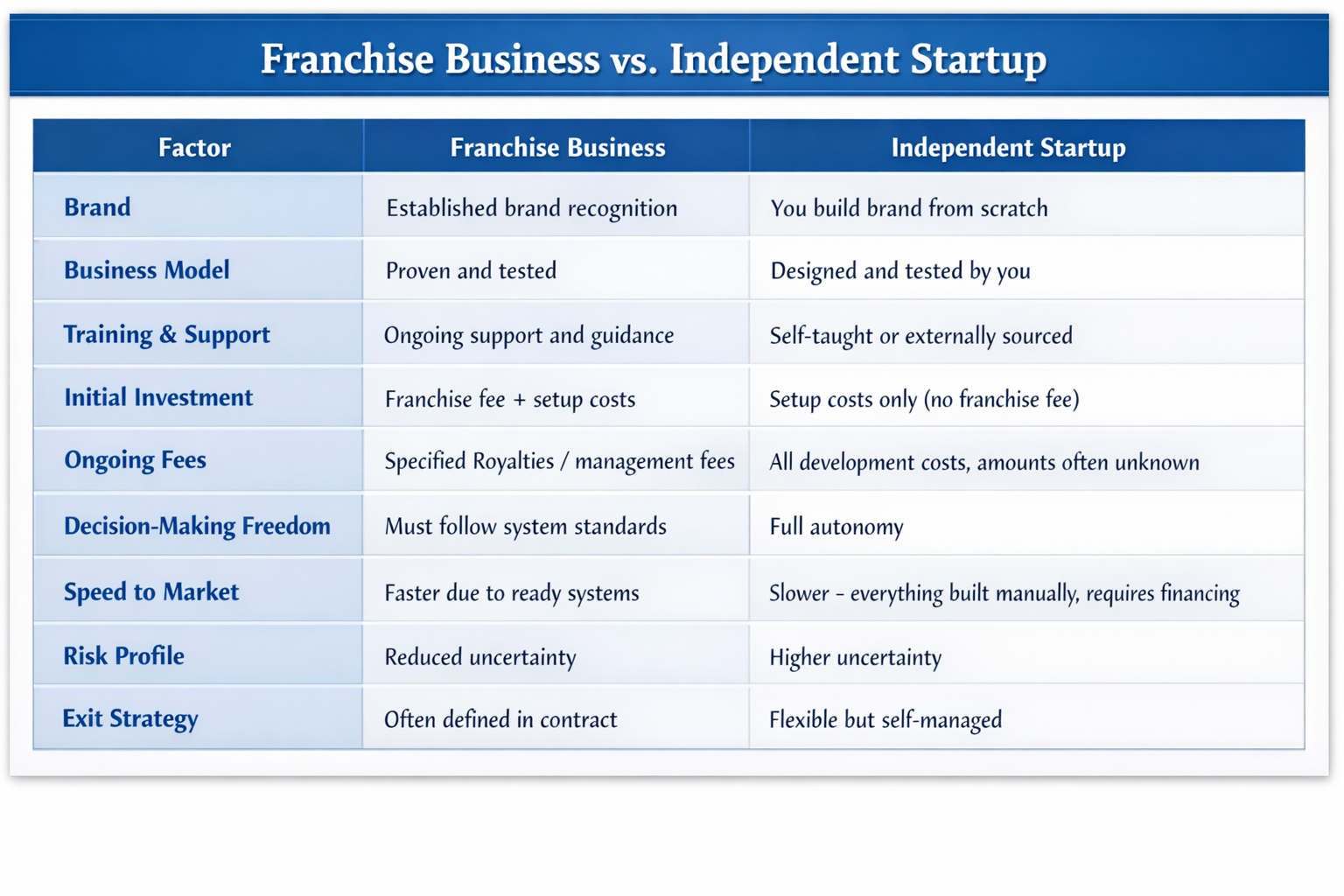
    Franchise vs Independent Business: What’s the Difference?

    Franchise Business vs Independent start up graphic.png

    The key difference isn’t whether one is “better.” It’s whether you value autonomy over structure or structure over autonomy.

    Franchising trades some creative freedom for reduced guesswork. Independent business offers total control but total responsibility for designing every system from scratch.

    In my experience, the decision between franchising and starting independently is less about which is superior and more about personality alignment. Entrepreneurs who value autonomy above all else may find franchise systems restrictive. Those who value structure, frameworks and shared learning often accelerate faster within one.

    The Misunderstanding That Causes Problems

    Franchising has polished itself very well over the years.

    Brochures are sleek.

    Case studies look effortless.

    Awards shine.

    And somewhere along the way, parts of the sector allowed people to believe this was “safe” business ownership.

    It is structured.

    It is supported.

    It is lower risk than starting blindly.

    It is not risk free.

    As the leader of a nationwide franchise network, I can tell you this with confidence:

    The franchisees who succeed are not necessarily the most experienced or the most confident.

    They are the ones who respect the box.

    They follow the process inside it.

    They ask for support when they wobble.

    They keep marketing when the phone is quiet.

    They keep recruiting when it feels uncomfortable.

    They treat it like the business it is.

    Franchising is not for people who resent structure, resist accountability, or expect income without leadership responsibility.

    The franchising sector has matured significantly over the past two decades. However, as with any industry, not all franchise opportunities are created equal. Commercial performance varies widely depending on leadership, model strength, sector demand and individual execution.

    Due diligence matters.


    So What Is Franchising, Really?

    Franchising is entrepreneurship with scaffolding.

    It is ownership with parameters.

    It is independence within a contractual framework.

    It reduces uncertainty. It does not remove responsibility.

    For some, that structure is empowering. For others, it feels restrictive. The difference lies in expectations.

    If you’ve been weighing up whether franchising is a shortcut or a smart structure, you now understand what it really is, ownership with support, not ownership without responsibility.

    The question isn’t whether the box looks impressive. It’s whether you’re ready to use it.

    As someone who works daily within the franchising sector, I’ve seen how powerful this model can be when understood properly and how damaging misunderstandings can be when it isn’t.

    If you’re comparing franchising with starting independently, your next step should be understanding the real cost differences between the two including franchise fees, royalties and hidden expenses.

    That’s exactly what we’ll break down in the next article so you can assess franchising with clarity rather than optimism.

    Sam Acton is the founder of the Domestic Angels network of small businesses. She is a Member of the BCP Council Audit & Governance Committee and a Trustee of the Healthbus Charity. Sam has over 20 years’ experience building and supporting SMEs and regularly contributes to discussions on employment, governance and sustainable business growth in Westminster. https://www.linkedin.com/in/sam-acton/

    Blogs

  • Day One Statutory Sick Pay Is Coming
    S sam

    Here’s what I’ve been thinking about and what we’ve been doing so far.

    Like it or not, day one statutory sick pay is being introduced. For many small and medium-sized businesses like mine, it will change the cost and risk profile of employing people.

    Much of the commentary so far has focused on whether this is fair, affordable, or another burden on employers. Those debates will continue and I absolutely encourage you to get involved, say your bit and fight your corner. It’s essential. Having a voice is a privilege. At the same time though, the more useful question is a practical one:

    Is your business designed to absorb absence, or does it rely on perfect attendance to function?

    Because the legislation itself is not what creates pressure. It exposes it. Let me explain.

    Absence has always been a cost. We just didn’t have to face it on day one.

    Sickness absence is not new. What is changing is who carries the cost, how quickly it appears, and how visible it becomes.

    In many SMEs, absence has traditionally been absorbed informally:
    • Work redistributed at short notice
    • Owners stepping in
    • Standards slipping temporarily
    • Overtime increasing
    • Productivity dipping without being measured

    In short, all rather relaxed, flexible and human.

    Day One SSP does not create absence, but it forces us all as business owners to acknowledge its real financial impact rather than hoping it evens out over time.

    The real risk is dependency, not legislation

    The businesses that feel this change most sharply are not the smallest or the least profitable. They are the ones that rely heavily on individuals rather than systems.
    Where one person not turning up means:
    • Work cannot be delivered
    • Customers are affected immediately
    • The owner is pulled back into operations
    • Costs rise without warning

    That is not a sick pay problem. It is an operating model problem which in a labour dependent business is a headache of a challenge.

    What we’ve changed in practice, and why it matters now

    Ours is a labour dependent business where people work alone and independently, absence has a direct and immediate impact. Probably one of the worst business scenarios. There is no easy cover, no shared workload, and no buffer.

    So rather than pretending this legislation will not affect behaviour, we have accepted that it requires a more structured and deliberate approach to absence management.
    That does not mean being unkind. It means being clear.

    Here are some of the changes we have introduced that you may want to consider.

    1. Tighter absence reporting rules
    A text message for any absence is no longer sufficient. If someone is unwell, they must phone in and have a conversation for each day they are self-certifying. This removes ambiguity and reinforces that absence is a live operational issue, not an admin task.

    2. Daily self-certification during absence
    Staff are required to complete a self-certification form for each day they are absent. This creates consistency, clarity and a proper record, rather than relying on memory or informal updates.

    3. More formal return-to-work conversations
    Return-to-work interviews are now structured and recorded. They are not disciplinary by default, but they are purposeful. They provide an opportunity to understand what happened, reset expectations and identify any underlying issues early.

    4. Using data to spot patterns, not to punish
    Recording absence properly puts managers and business owners in a much stronger position to see patterns that need addressing. This might be repeated short-term absence, timing issues, or workload pressures. Without records, none of that is visible or useful in a disciplinary scenario.

    5. Tighter medical information at recruitment
    Whilst you cannot force disclosure, you can be clear about expectations. Our medical forms are more robust, and where something surfaces later that was not disclosed up front, we are in a stronger position to challenge the revelation through a fair but informed conversation.

    6. Clear boundaries around what counts as sickness
    Being off because off for a sick pet or for great aunty ‘Tilda twice removed’s funeral is no longer an affordable option. These situations require different conversations and different solutions. Blurring the lines helps no one.

    7. Training managers to handle this properly
    We are rolling out structured training for our managers, they are franchisees so business owners like yourself, so they can adapt confidently to this more formal, belt-and-braces approach. This is essential. Poorly handled absence management damages trust and costs money. Done well, it creates clarity and consistency.

    8. Reviewing and re-launching absence policies
    Policies have been reviewed, updated and simplified. Everyone knows where to find them and what they say. A policy that exists but is not understood is no protection for anyone, at all.

    If you are an SME owner who is used to being flexible and human, trust me, I hear and feel your pain with these changes. The discipline and additional admin, yuk. Try focussing on the output, absence reduction=cost reduction. You can do it.

    The uncomfortable conversation - pricing

    Day One SSP is inflationary. There is no value in pretending otherwise.
    Please do not sit back and wonder whether you can absorb the additional cost of Day One SSP. The government has legislated it, just as it legislates for the Living Wage. That means, like it or not, there is now another cost element that needs to be passed on to customers over time.

    Most businesses already have a formula they use for annual price reviews to cover increases such as Living Wage, National Insurance and general overheads. Day One SSP now needs to sit alongside that as a separate consideration.

    If you are not a numbers-happy person (you’re in good company), this will feel like a pain in the proverbial. There is no neat rule of calculation that fits every business type or sector.

    We approached it pragmatically. We looked at national average sickness figures from two recognised sources. One quoted 9.5 days per year, the other 4.5. Not hugely helpful, so we settled on 7 days as a median and ran our calculations from there.
    Is it perfect? Probably not. Will it be sufficient? Time will tell.

    But we have done something. And at this point, doing something sensible and documented to protect your bottom line is far better than doing nothing and hoping it all evens out.

    My final thoughts
    If you’ve been in business for some time and this feels overwhelming, remember you pivoted through a pandemic, so you can definitely pirouette through an Employment Rights Act.

    The introduction of day one statutory sick pay is as much about business resilience as it is personal resilience. You do have a bit of time yet, so break things down. Tasks, decisions, ideas for your business. Cup-of-tea-sized chunks. Don’t aim for perfection, just aim for done. You can polish it later.

    And for those of you with an appetite for lobbying, remember the game isn’t up yet. Your MP and your favourite journo need to hear from you. Real-life stories, facts and figures, shared while legislation is being proposed and introduced, really do influence how it forms (or so I’m always being told). You are a business leader, and your voice matters.

    Sam Acton is the founder of the Domestic Angels network of small businesses. She is a Member of the BCP Council Audit & Governance Committee and a Trustee of the Healthbus Charity. Sam has over 20 years’ experience building and supporting SMEs and regularly contributes to discussions on employment, governance and sustainable business growth in Westminster. https://www.linkedin.com/in/sam-acton/

    Blogs
  • Login

  • Don't have an account? Register

  • Login or register to search.
Powered by NodeBB Contributors
  • First post
    Last post
0
  • Categories
  • Recent
  • Tags
  • Popular
  • Users
  • Groups